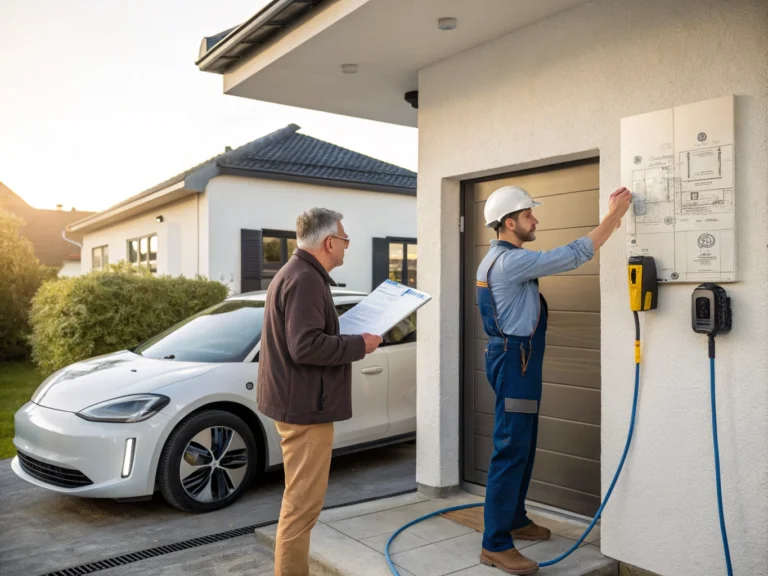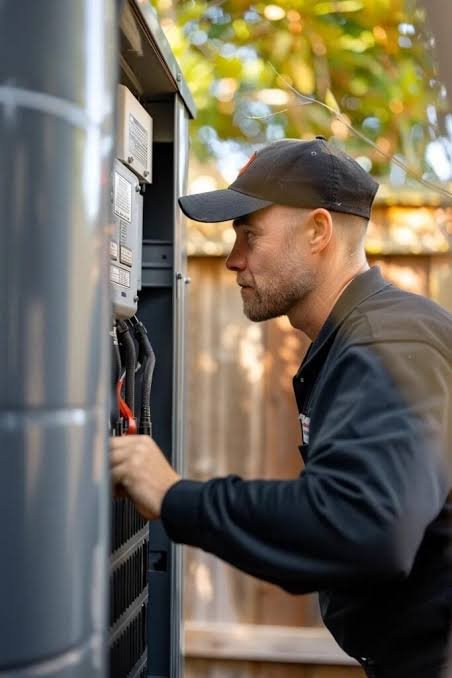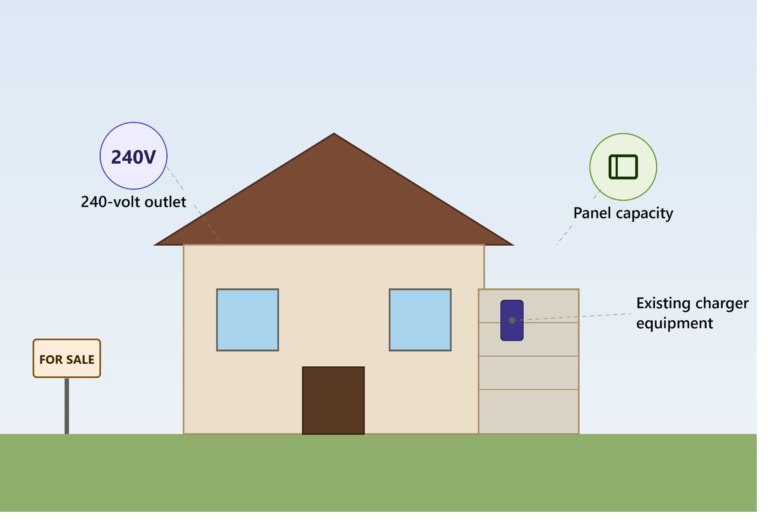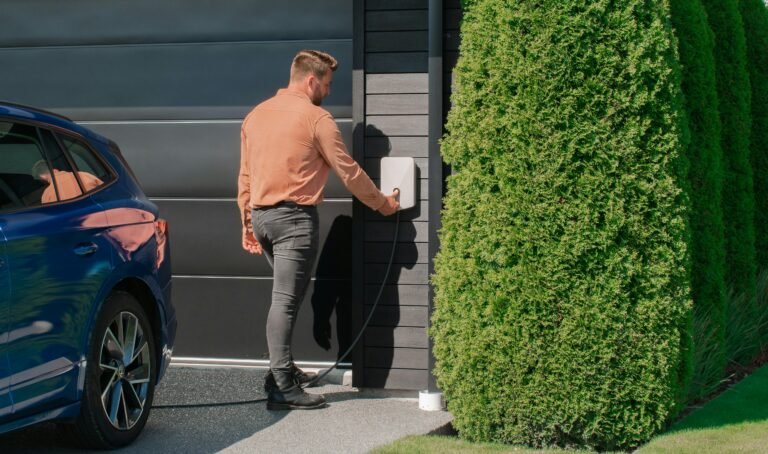
The gap here is bigger than most homeowners expect: adding EV charger wiring during new construction or an open-wall renovation typically costs $200-650, while the identical circuit installed as a standalone retrofit after the home is finished runs $800-2,700 — and can climb to $2,000-6,000+ in more complex retrofit scenarios. Same wire, same outcome, vastly different price. Here’s exactly why, and what it means for your timing decision.
The Core Numbers
| Scenario | Typical cost |
|---|---|
| Wiring added during new construction or open-wall renovation | $200-650 |
| Standard retrofit (finished home, straightforward path) | $800-2,700 |
| Complex retrofit (older home, 100A panel, detached garage, long conduit run) | $2,000-6,000+ |
| Commercial/multi-unit retrofit vs. building EV-ready at construction | 40-60% more expensive |
The commercial figure is worth noting even for homeowners, since it comes from DOE and NREL project data and illustrates the same underlying principle at scale: retrofitting is consistently, measurably more expensive than building it in from the start, regardless of project size.
[AD BREAK — insert in-content ad unit here]
Why New Construction Is So Much Cheaper
The cost gap isn’t arbitrary — it comes down to a few concrete factors that all point the same direction:
- Walls are already open. Running 6-gauge wire from panel to garage costs roughly $200-400 while framing is exposed, versus $500-1,000+ for the identical run once drywall is up and needs to be cut into and repaired afterward.
- The electrician is already on-site. Adding a 240V circuit during a permitted renovation or new build is typically a 1-2 hour add-on to work already happening, not a separate service call that carries its own trip charge and setup time (often $150+ on its own).
- Panel upgrades get bundled essentially for free. If you’re already upgrading from 100A to 200A service for other renovation reasons (a common trigger for kitchen remodels, additions, or whole-house rewiring), adding the EV circuit onto that same upgrade costs very little extra, since the expensive part — the panel work itself — is happening regardless.
- One permit covers both. Most jurisdictions allow adding an EV charger circuit to an existing renovation or construction permit for a modest revision fee (commonly $50-150), rather than requiring a completely separate permit process later.
- No demolition or repair costs. Retrofitting into a finished home frequently requires breaking into and repairing walls, and longer conduit runs where a direct path isn’t available — costs that simply don’t exist when the walls aren’t closed up yet.
What Drives Retrofit Costs Higher
When you’re adding a charger circuit to an already-finished home, a few factors specifically inflate the cost compared to the new-construction scenario:
- Wall and drywall repair — cutting into finished walls to run wire, then patching and repainting afterward
- Longer or more complex conduit runs — especially for detached garages, where underground conduit trenching adds substantial labor and materials cost
- Panel capacity issues discovered after the fact — a retrofit project sometimes reveals a panel that needs upgrading specifically to support the new load, a cost that wouldn’t have been a surprise if planned during initial construction
- Older home factors — homes with 100A service, panels located far from the garage, or non-standard electrical setups add complexity that simply doesn’t exist in new construction built with modern standards from the start
[AD BREAK — insert in-content ad unit here]
The Case for Pre-Wiring Even If You Don’t Own an EV Yet
This is the most actionable takeaway for homeowners: if you’re planning any renovation that opens walls between your electrical panel and garage in the next year or two — even one unrelated to EVs — it’s worth adding the circuit now.
The math is compelling: adding EV-ready wiring during a renovation costs roughly $200-650, while real estate data shows EV-charging-ready homes commanding a 1.5-3% price premium in markets with strong EV adoption. On a $400,000 home, that’s a $6,000-12,000 potential resale value increase against a $200-650 incremental cost during construction — a favorable return even if you never personally own an EV and simply sell to a buyer who does.
Practically, this means: run the conduit and wiring now, and install the actual charger unit later whenever you (or a future buyer) actually need it. The expensive part — the buried-in-the-wall labor — is what benefits most from being done while things are already open; the charger itself is a comparatively simple add-on anytime later.
When Retrofit Is Simply Unavoidable
Realistically, most homeowners reading this already live in a finished home with no renovation currently planned — for that situation, retrofit is simply the path, and there’s no practical way to access new-construction pricing. In that case, focus on controlling what you can:
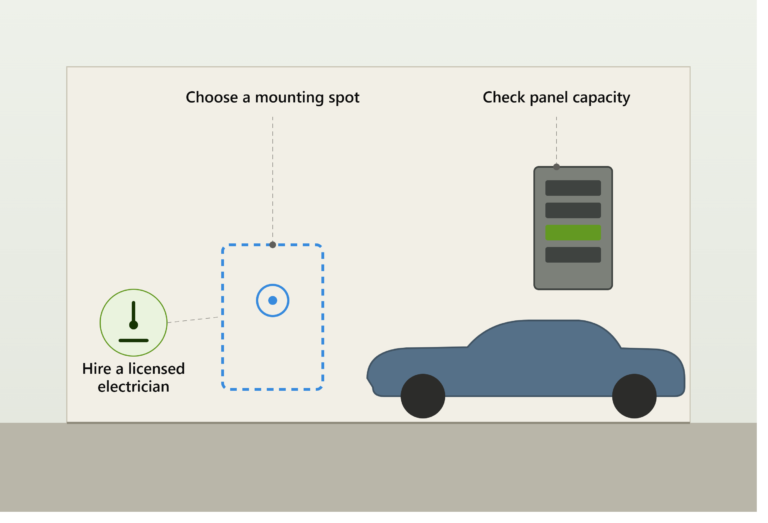
- Get a load calculation first (see our guide on calculating home electrical capacity) — a large share of homes don’t actually need a panel upgrade, and confirming this before getting quotes prevents overpaying for unnecessary work
- Choose the shortest reasonable path from panel to charger location — mounting on the wall closest to your panel, rather than the far side of the garage, meaningfully reduces conduit and wire costs
- Ask about permit bundling if you have any other electrical work planned in the near term, even unrelated to the charger — combining trips and permits saves money on both
Bottom Line
New construction and open-wall renovations offer EV charger wiring at a genuine fraction of retrofit cost — often 3-4x cheaper for the same electrical work — purely because of timing, not because anything about the job itself is different. If you have any renovation on the horizon, adding this wiring now is one of the highest-ROI small additions available, whether or not you own an EV yet. If retrofit is your only option, a proper load calculation and thoughtful charger placement are your best levers for keeping costs controlled.
Costs vary by region, home configuration, and local labor rates. Get quotes from licensed electricians for your specific situation before finalizing a project budget.