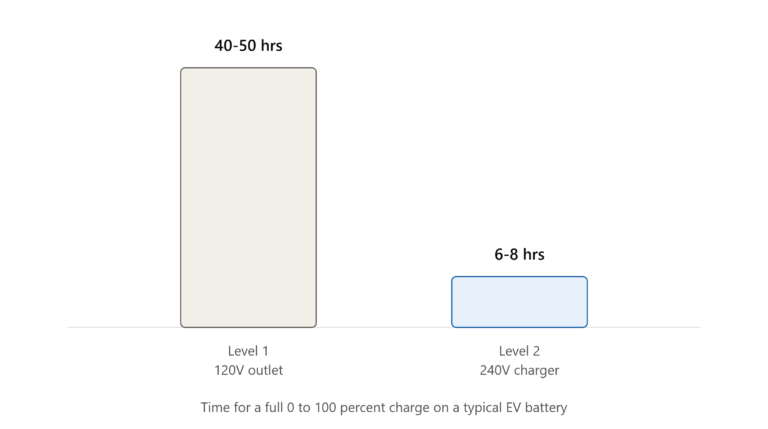
Every Level 2 EV charger connects to your home one of two ways: hardwired directly into your electrical panel, or plugged in to a 240V outlet. Neither option is universally “better” — the right choice depends on whether you’re renting or own, how long you plan to stay, and how much you value speed versus flexibility. Here’s an honest breakdown of both.
How Each One Actually Works
Hardwired: A dedicated 240V circuit runs from your breaker panel directly to the charger’s mounting location. There’s no outlet involved — an electrician strips the wires and connects them inside the charger’s junction box, similar to how a ceiling fan is permanently wired in. Once installed, it’s a fixed part of your home.
Plug-in: The charger connects to a 240V outlet — most commonly a NEMA 14-50, the same style used for an electric dryer or RV hookup. If that outlet already exists in your garage, you can literally plug in a charger and start using it the same day, no electrician required.
Pros and Cons at a Glance
| Hardwired | Plug-In | |
|---|---|---|
| Max amperage | Up to 48A | Capped at 40A by code |
| Installation | Requires an electrician every time | DIY possible if outlet exists |
| Portability | Permanent — stays with the house | Unplug and take it if you move |
| Upgrade path | Call an electrician to swap units | Swap chargers yourself in minutes |
| Outdoor durability | No outlet exposed to moisture | Outlet is a possible weak point outdoors |
| Typical extra cost | Higher (professional labor every change) | Lower if outlet already exists |
The Case for Hardwired
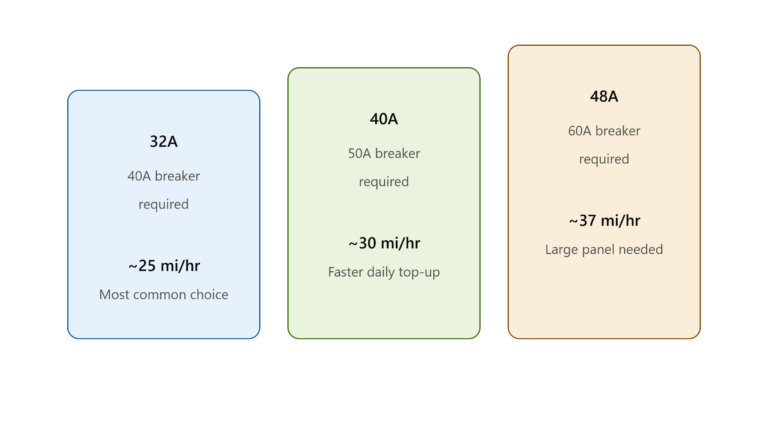
More power, full stop. Hardwired chargers can deliver up to 48 amps (11.5 kW) on a 60-amp circuit — about 20% faster than what a plug-in setup can legally provide, since NEMA outlets are code-capped at 40 amps regardless of what charger you attach to them.
Fewer points of failure. Every plug-and-outlet connection is a place where resistance — and therefore heat — can build up over years of nightly high-current use. Hardwiring eliminates that connection entirely, which matters especially for continuous 8-12 hour charging sessions. There’s a real, well-documented issue in the industry with lower-quality NEMA 14-50 outlets degrading or even melting under the sustained heat of regular EV charging — a hardwired setup sidesteps this risk completely.
No GFCI conflicts. Modern code requires GFCI (ground fault) protection on outlet circuits, and EV chargers already have their own built-in GFCI protection. Stack two GFCI systems on the same circuit, and they can interfere with each other — a common cause of chargers that mysteriously trip the breaker in the middle of the night. Hardwiring avoids this entirely because there’s no outlet-level GFCI to conflict with.
Better for outdoor installs. No exposed outlet means fewer entry points for moisture, which matters if your charger is mounted outside rather than in a garage.
The tradeoff: it’s permanent. If you move, the charger stays with the house, and any future upgrade means calling an electrician again rather than a quick swap.
The Case for Plug-In
Lower cost if the outlet already exists. If your garage already has a NEMA 14-50 outlet — common in homes with an electric dryer or RV hookup — you can have Level 2 charging running in about 15 minutes with zero electrician visit and zero permit. Your total cost is just the charger itself, which can be as low as $150-200 for a budget model.
Portability. Moving houses, or just want to bring your charger along? Unplug it and take it with you — something a hardwired unit simply can’t do.
Easy upgrades. The home EV charger market moves fast, with better features and speeds arriving regularly. A plug-in setup lets you swap to a newer charger in minutes whenever you want to upgrade. Hardwired means scheduling an electrician every time.
Shared-use flexibility. Some homeowners use the same NEMA 14-50 outlet for their EV charger and their electric dryer or RV — not simultaneously, but it means one outlet can serve double duty if garage space is tight.
The tradeoff: it’s capped at 40A by code, adds a connection point that requires quality hardware to avoid overheating, and can run into the GFCI nuisance-tripping issue described above.
So Which Should You Choose?
Go plug-in if:
- You’re renting, or plan to move within a few years
- A NEMA 14-50 outlet already exists in your garage
- You want the lowest possible upfront cost
- You like the flexibility to upgrade chargers easily
Go hardwired if:
- You own your home and plan to stay long-term
- You want the maximum charging speed available (48A)
- Your charger will be mounted outdoors, where moisture is a factor
- You have a large-battery EV or truck that benefits from the extra power
- You’d rather pay once for a clean, permanent setup than deal with an exposed outlet for years
One Important Note If You Go Plug-In
If you do choose a plug-in setup, don’t cut corners on the outlet itself. Cheap, big-box-store NEMA 14-50 outlets are frequently built for appliances that cycle on and off briefly — not the sustained, marathon heat of overnight EV charging. Investing in a quality, properly rated outlet (and having it installed correctly) is what actually determines whether a plug-in setup performs safely for years, rather than becoming a maintenance headache.
Bottom Line
Plug-in works well for renters, movers, and anyone prioritizing flexibility and lower upfront cost — especially if a compatible outlet already exists. Hardwired is the stronger long-term choice for homeowners who want maximum charging speed, fewer points of failure, and a cleaner, more permanent setup, and it’s often “practically mandatory” for outdoor installations. Neither option is unsafe when installed correctly — the real safety factor is quality installation and equipment, not which of the two you pick.
This article is for general informational purposes. Consult a licensed electrician to determine which setup is appropriate for your home’s electrical system and your specific charger model.