Yes — plugging your EV’s included charging cable into a standard 120V household outlet (the same kind you’d use for a lamp or phone charger) is a fully supported charging method, known as Level 1 charging. But “can you” and “should you do it exactly how most people are tempted to” are two different questions. Here’s what actually matters for doing it safely.
What Counts as a “Regular Outlet”
In most U.S. homes, a regular outlet is a 120-volt, 15-amp household receptacle — standard in nearly every room. Every EV comes with a Level 1 charging cable in the trunk that’s designed to plug directly into exactly this kind of outlet, with a J1772 or NACS connector on the other end for the car. No adapter, no special equipment, no electrician required to get started.
Level 1 charging typically draws about 12 amps continuously — well within what a properly functioning, code-compliant outlet is designed to handle for extended periods.
The Condition of the Outlet Matters More Than People Think
This is where most of the real risk actually lives. A brand-new, properly wired outlet handles Level 1 charging without issue. An old, worn, or already-overloaded outlet is a different story, because EV charging isn’t a quick few minutes like a toaster — it’s a continuous draw for 8-12+ hours, which is far less forgiving of a weak connection than typical appliance use.
Before you plug in for the first time, check for:
- Cracks, yellowing, or browning around the outlet or plug
- Looseness — does the plug fit snugly, or does it wiggle in the socket?
- A warm or hot outlet after charging has been running for a while (it should stay close to room temperature)
- Any burning smell — this means stop immediately and call an electrician
If you notice any of these, don’t charge from that outlet until it’s inspected or replaced.
Ideally, Use a Dedicated Circuit
A “dedicated circuit” means the outlet you’re charging from isn’t shared with anything else — no refrigerator, no power tools, no other appliances pulling from the same breaker at the same time. This matters because if your EV is drawing 12 amps continuously and something else on the same circuit kicks on, you can trip the breaker or, worse, overload wiring that wasn’t sized to carry both loads at once.
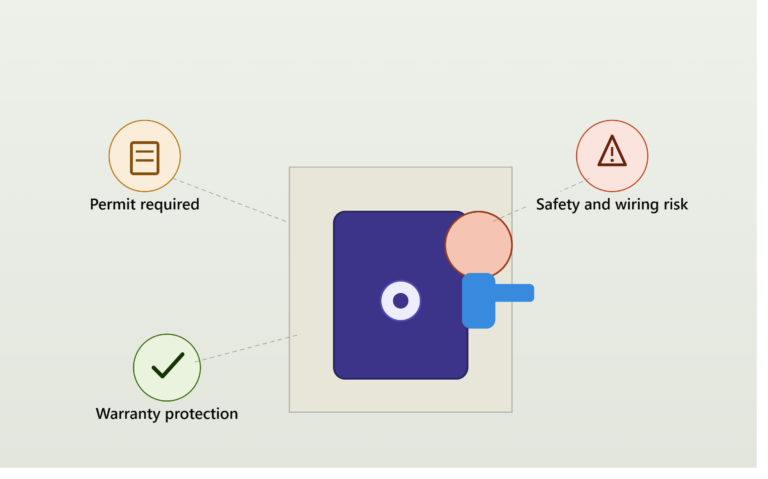
If your garage outlet is on a shared circuit with something like a freezer or sump pump, it’s worth having an electrician check whether it’s suitable for regular overnight EV charging, or whether a dedicated outlet makes more sense.
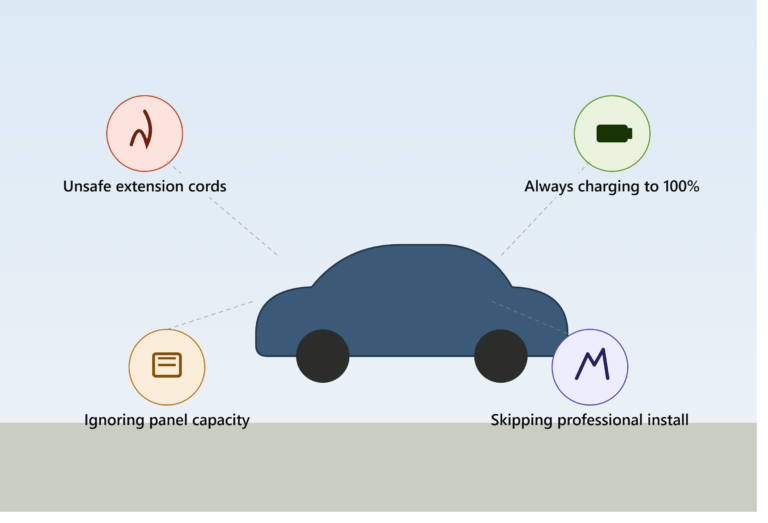
Do Not Use an Extension Cord
This is the one piece of advice that shows up consistently across automakers, electricians, and safety organizations, and it’s worth taking seriously: the Electrical Safety Foundation International explicitly warns that using a standard extension cord for EV charging is a fire and shock hazard.
The reason comes back to that same continuous-load problem. Regular extension cords are built for short, occasional use — a lamp, a fan, holiday lights. They’re not designed to carry a steady 12-amp draw for half a day at a time, night after night. Over time, this can cause:
- Overheating at the plug or along the cord
- Melted insulation
- Loosening connections that lead to arcing — a real fire risk
- Voltage drop that actually slows down your charging
Even cords marketed as “heavy-duty” or “EV-rated” don’t have a universally recognized safety standard behind that label, and manufacturers and safety organizations generally recommend against relying on them for regular charging. If your parking spot is too far from an outlet, the fix is a dedicated outlet or a longer charging cable installed by an electrician — not a workaround with a cord from the hardware store.
Signs You Should Stop and Call an Electrician
Treat any of the following as a reason to unplug and get the setup checked before charging again:
- The outlet, plug, or cord feels hot to the touch (slightly warm is normal; hot is not)
- You smell anything burning or notice discoloration
- The breaker trips repeatedly during charging
- The plug feels loose or doesn’t seat firmly in the outlet
None of these are “keep an eye on it and see” situations — continuous overnight charging means a small problem has hours to get worse before anyone notices.
When It’s Time to Upgrade
Charging from a regular outlet works well for low-mileage driving, but it has real limits: roughly 3-5 miles of range per hour, meaning heavy commuters can find themselves consistently behind on range. If you’re regularly arriving home with a nearly empty battery, or you just want charging that isn’t a nightly variable to think about, that’s usually the signal to look at a dedicated 120V circuit or a full Level 2 setup (we cover that comparison in our Level 1 vs. Level 2 guide).
Bottom Line
Charging from a regular outlet is safe and fully supported — as long as the outlet is in good condition, ideally on a dedicated circuit, and you’re using the cable that came with your car rather than an extension cord. It’s a legitimate long-term solution for light driving, not just a stopgap, but it does deserve the same basic attention you’d give any appliance that runs continuously for hours: check the outlet periodically, and don’t ignore warning signs like heat or unusual smells.
This article is for general informational purposes. If you have any doubt about your outlet’s condition or your home’s wiring, have a licensed electrician inspect it before charging.