If you just brought home your first EV, it came with a charging cable in the trunk that plugs into any regular wall outlet. That’s Level 1 charging, and it works — but not the way most new owners expect. This guide breaks down exactly what separates Level 1 from Level 2, what each one actually costs, and how to figure out which one your household really needs.
What Is Level 1 Charging?
Level 1 charging uses a standard 120-volt household outlet — the same kind that powers a lamp or a phone charger. Every EV comes with a portable Level 1 cable (called an EVSE) in the trunk, so technically, you can start charging the day you bring the car home with zero installation and zero extra cost.
The catch is speed. Level 1 delivers only about 1.2-1.4 kW of power, which translates to roughly 3 to 5 miles of range per hour. Plugged in overnight for 10-12 hours, that adds up to about 30-50 miles — enough for many people’s daily commute, but not much of a buffer beyond that.
What Is Level 2 Charging?
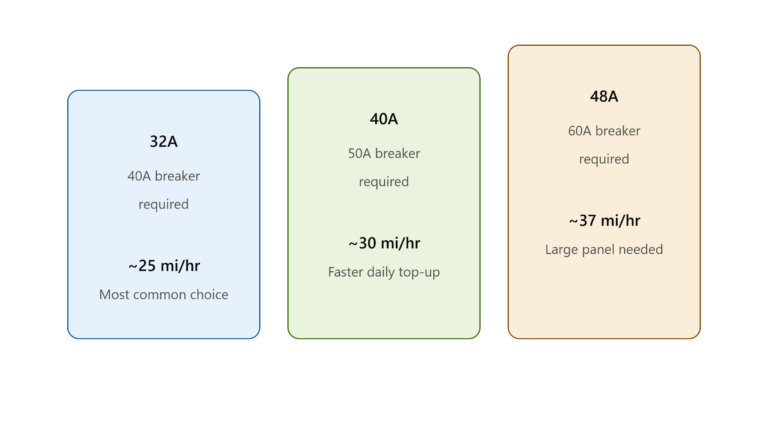
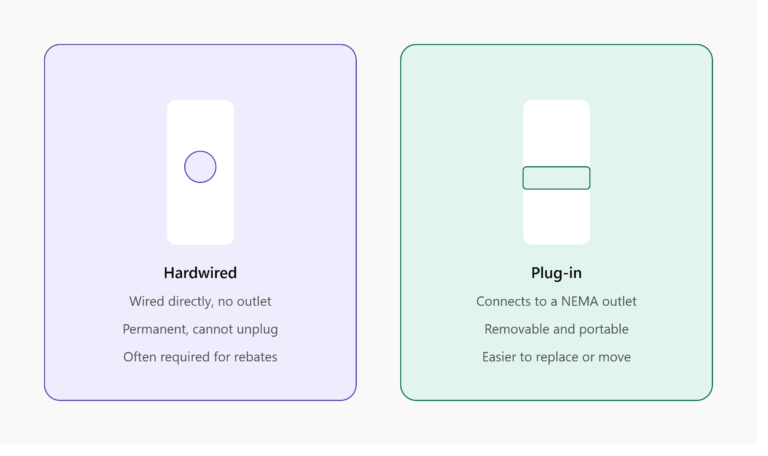
Level 2 charging steps up to a 240-volt circuit — the same heavy-duty power level used by an electric dryer or a central air conditioning unit. This isn’t something you can just plug into an existing outlet in most homes; it requires a licensed electrician to install a dedicated 240V circuit, either as a heavy-duty outlet (commonly a NEMA 14-50) or hardwired directly into your electrical panel.
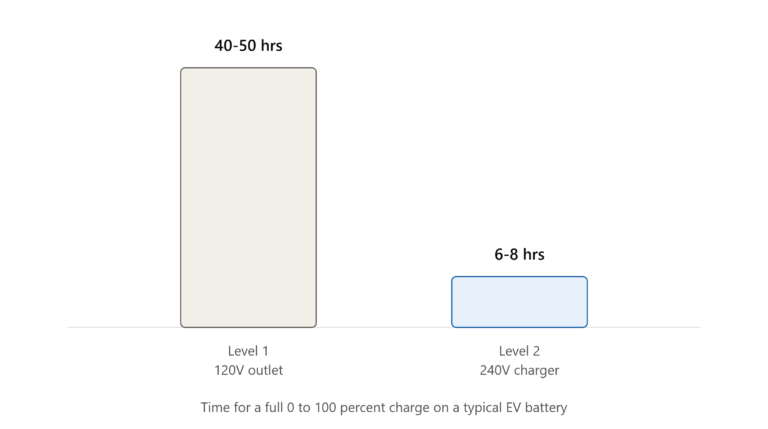
The payoff is a major speed increase: Level 2 typically adds 15 to 45 miles of range per hour, depending on your charger’s output and your vehicle’s onboard charging capacity. A full charge that takes 40-60 hours on Level 1 can be done overnight on Level 2.
[AD BREAK — insert in-content ad unit here]
Speed Comparison at a Glance
| Level 1 | Level 2 | |
|---|---|---|
| Voltage | 120V | 240V |
| Power output | ~1.2-1.4 kW | Typically 6.6-11.5 kW |
| Range added per hour | 3-5 miles | 15-45 miles |
| Full charge (large battery) | 40-60+ hours | 6-10 hours |
| Installation needed | None | Licensed electrician |
One detail almost nobody mentions upfront: your car’s onboard charger sets the real ceiling, not just the wall unit. Some EVs (like the Chevy Bolt or Toyota RAV4 Prime) can only accept up to 6.6-7.2 kW no matter how powerful a charger you install, while others (like many Hyundai and Kia models) can take 11+ kW. Buying a more powerful Level 2 charger than your car can actually use won’t make it charge any faster — check your vehicle’s maximum AC charging rate before you buy.
Does Level 1 and Level 2 Cost Different Amounts to Run?
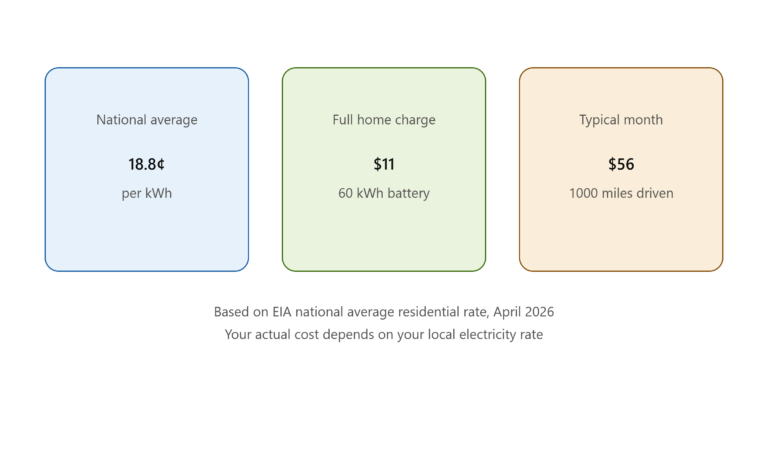
Here’s a detail that surprises a lot of new owners: charging at Level 1 and Level 2 costs roughly the same per kWh, because you’re paying your regular residential electricity rate either way — the charging level only changes how fast the power flows, not the price per unit. At the U.S. average residential rate of about $0.16/kWh, that works out to roughly $0.04 per mile driven on either level.
The real cost difference isn’t in the electricity — it’s in the installation.
Installation Cost: The Real Deciding Factor
- Level 1: $0. You’re using an outlet you already have.
- Level 2: Typically $749 to $2,500, with $1,700 being a fairly common cost for a standard installation. The range depends on how far your electrical panel is from your parking spot, whether your panel has enough spare capacity, and local electrician rates.
Some households can offset part of this through utility rebates or tax credits — worth checking before you commit to a quote (we cover current incentive programs in a separate guide, since these change often).
So, Which One Do You Actually Need?
This comes down to one honest question: how many miles do you drive on a typical day?
Level 1 is genuinely enough if:
- You drive less than 30-40 miles per day
- You have access to workplace charging some days
- You have a plug near your parking spot and want to avoid the installation cost for now
Level 2 makes sense if:
- You regularly drive more than 40 miles a day
- You want the flexibility to fully charge overnight regardless of how depleted the battery is
- You’re charging more than one EV at home
- You want to take advantage of off-peak electricity rates, which usually require a full overnight charge window that Level 1 can’t complete in time
That last point matters more than people expect: many utilities charge less for electricity late at night. Level 2 can fit a full charge into that cheap window; Level 1 often can’t, meaning some of your charging spills into more expensive daytime rates. Over a year, that gap alone can add up to a few hundred dollars — which helps explain why a lot of owners who start on Level 1 end up upgrading within their first year.
The Bottom Line
Level 1 isn’t a “starter” option to be embarrassed about — for low-mileage drivers, it can be a perfectly permanent solution that costs nothing to set up. Level 2 is an upgrade in convenience and speed, not a requirement, and whether it’s worth the $750-$2,500 investment depends entirely on your daily driving distance, not on what feels like the “proper” way to own an EV.
If you’re not sure yet, the simplest approach is to start with the Level 1 cable your car came with, track how much range you actually need to replace each day for a couple of weeks, and use that real number — not a guess — to decide if Level 2 is worth it for your household.
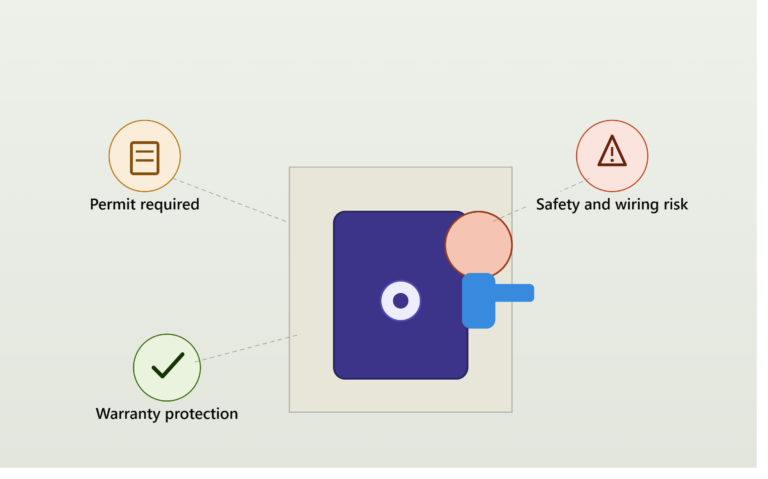
This article is for general informational purposes. Always consult a licensed electrician before installing a home EV charging circuit to ensure it meets your home’s electrical capacity and local code requirements.