If your utility bill has crept up since you started charging an EV at home — even though you thought you were charging overnight — the reason is usually a rate structure you haven’t fully mapped out yet. Time-of-use pricing doesn’t just affect your EV charging; it changes the cost of everything you run at home, based on when you run it. Here’s how these rate structures actually work, and how to make sure they’re working for you instead of against you.
Three Different Rate Structures, Explained
Utilities generally bill residential customers under one of three structures:
- Flat rate: the same price per kWh no matter when you use electricity — simple, but increasingly rare as more utilities shift toward time-based pricing
- Tiered rate: price increases once your total usage crosses a threshold within a billing period, regardless of when you used it
- Time-of-use (TOU) rate: price changes based on the time of day (and sometimes the season), with higher rates during peak demand hours and lower rates overnight
EV charging interacts most directly with TOU rates, since it’s one of the few large, flexible loads you can genuinely control the timing of. But it’s worth checking which structure you’re actually on — some utilities have shifted customers to TOU by default, and not everyone has noticed.
Why Peak Hours Cost More
Peak hours reflect actual grid stress. When millions of people run air conditioning on a hot afternoon, or come home from work and start cooking, running appliances, and charging cars all around the same time, utilities have to bring expensive, fast-starting “peaker” power plants online to meet that spike in demand. TOU pricing exists to pass some of that real cost difference back to consumers — and to encourage shifting flexible usage to hours when the grid isn’t under the same strain.
Typical Peak Windows (They Vary by Season)
Most U.S. utilities follow a broadly similar seasonal pattern, though exact hours vary by provider:
- Summer peak: typically 2 PM-9 PM, June through September, driven almost entirely by air conditioning demand
- Winter peak: often a “double hump” — a morning spike (6-9 AM) as people wake up and heat their homes, and an evening spike (5-9 PM) as they return home and cook
- Off-peak “golden hours”: generally 11 PM-6 AM across most of the country, when grid demand is lowest and rates drop the most
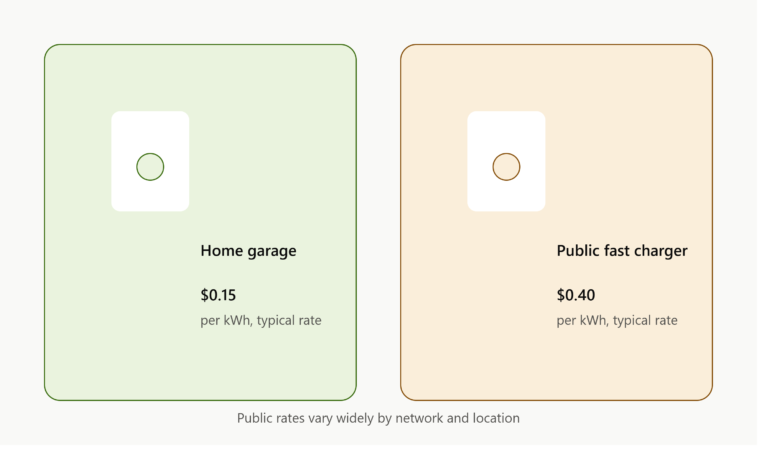
Some California utilities on TOU plans see peak rates as high as $0.50-0.65/kWh during the 4-9 PM window, compared to $0.20-0.25/kWh off-peak — a real illustration of how much this can move your bill if your usage doesn’t shift with the rate.
It’s Not Just Your EV — It’s Your Whole House
This is the part that catches people off guard: once you’re on a TOU rate, every appliance in your home is billed under that same schedule, not just your EV charger. Running the dishwasher at 7 PM, doing laundry after dinner, or cooking a big meal during peak hours all cost more under TOU pricing than they did under a flat rate — even for households without an EV at all. If your bill went up more than you expected after switching plans, it’s worth checking whether other evening habits, not just charging, are landing in the expensive window.
What About Demand Charges?
Separate from time-of-use pricing, some rate plans (more common for commercial customers, but present in some residential and EV-specific plans) include a demand charge — a fee based on your single highest 15-minute average power draw during the billing period, not your total energy used. If your home briefly pulls a lot of power at once (say, EV charging, AC, and an electric oven all running simultaneously), that peak moment can drive a real cost on your bill even if your total monthly usage is otherwise average. This is one more reason spreading out large loads — rather than running everything at once — can help keep costs down on certain rate plans.
You May Have Been Enrolled Automatically
In several states, TOU has become the default plan for new or existing residential customers rather than an opt-in choice. California is a notable example: PG&E, SCE, and SDG&E residential customers are generally defaulted to TOU pricing, though customers can typically request to remain on or return to a tiered, non-TOU plan by contacting their utility directly. If you’re not sure which structure you’re on, or don’t remember choosing TOU, check your utility account settings or a recent bill — the rate plan name is usually printed near your usage summary.
How to Actually Reduce the Impact
- Shift flexible loads to off-peak hours — EV charging, laundry, and dishwashing all have delay-start or scheduling options that let you load them in the evening and have them run automatically overnight
- Check for an EV-specific rate plan — some utilities offer better overnight rates specifically for EV owners than their general TOU plan provides (see our guide on setting up scheduled off-peak charging)
- Consider a smart panel if you’re managing multiple large loads (EV, heat pump, water heater) — devices like SPAN or Lumin can automatically prioritize and pause circuits based on the time of day and current rate tier, without you managing it manually
- Confirm you’re actually on the right plan for your usage pattern — TOU consistently helps households that can shift usage, but can genuinely cost more for anyone whose peak-hour usage (like daytime air conditioning needs) can’t realistically move
Bottom Line
Time-of-use pricing rewards flexible households and penalizes inflexible ones — and EV charging is one of the easiest loads to shift, since almost nobody needs their car charged at 6 PM specifically. Households that successfully move their EV charging and other flexible usage to off-peak hours commonly see 10-20% savings compared to a standard tiered plan, but the reverse is also true: if your evening routine can’t shift and you’re on a TOU plan by default, it’s worth checking whether a different rate structure actually suits your household better.
Utility rate structures, peak hour windows, and pricing change by provider, region, and season. Confirm your current plan and rates directly with your utility.