Based on current national averages, most EV owners spend $50 to $65 per month charging at home — compared to roughly $125 a month in gasoline for a comparable gas vehicle covering the same distance. But that headline number hides a lot of real-world variation depending on where you charge, when you charge, and how much of your driving relies on public stations. Here’s what owners actually report spending, not just the theoretical formula.
The Current National Numbers
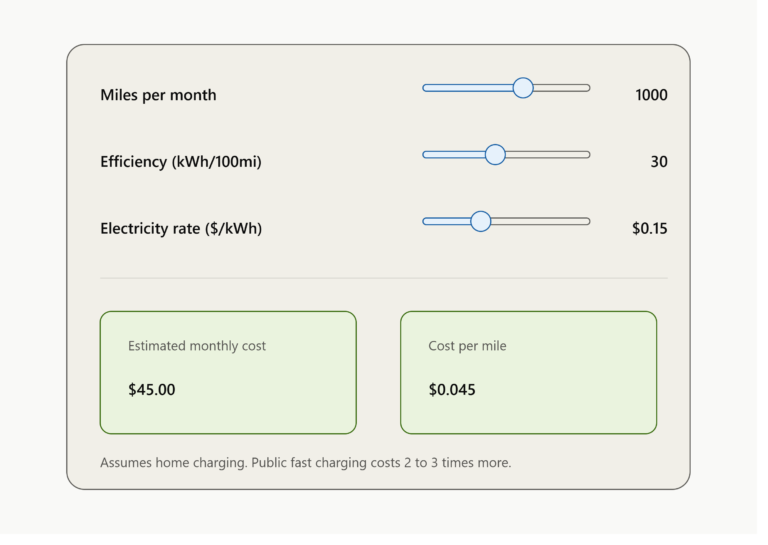
As of spring 2026, residential electricity averages about 18.8 cents per kWh (EIA data), while regular gasoline sits near $3.80 per gallon (AAA). At those rates, an efficient EV costs roughly 5-6 cents per mile to run on home electricity — meaning a driver covering 1,000 miles a month (close to the U.S. average) spends about $50-65 on home charging, versus roughly $125 in gas for a similar-distance gas vehicle. Over a five-year ownership window, that fuel-cost gap alone adds up to several thousand dollars.
[AD BREAK — insert in-content ad unit here]
Where You Charge Changes the Number a Lot
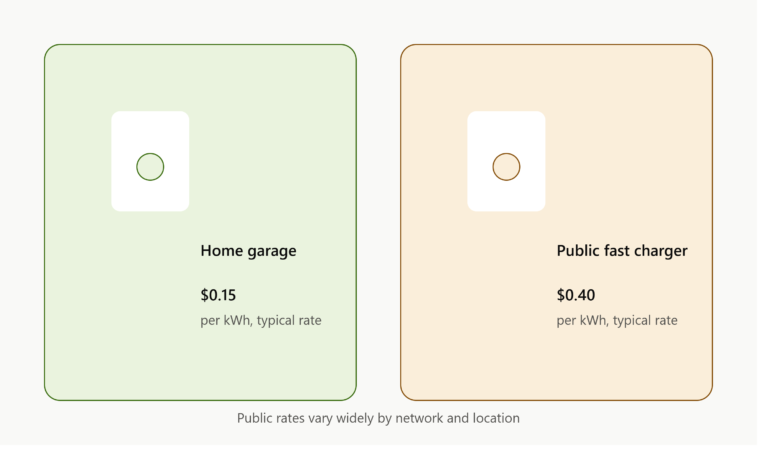
This is the detail flat “average monthly cost” figures tend to hide: not all charging happens at the same price. Public charging costs meaningfully more than home charging:
- Home electricity: averages about 19 cents per kWh
- Public Level 2: averages roughly 25-40 cents per kWh
- Public DC fast charging: AAA puts the national average around 41 cents per kWh, with peak-hour rates running higher still
Owners who rely heavily on public charging — because they lack home charging access, or simply charge on the go out of habit — end up paying substantially more per month than someone charging almost entirely at home. According to global survey data, EV owners charge privately (at home or at work) roughly 75% of the time and use public fast charging only about 10% of the time, which is a major reason average real-world running costs stay well below gas vehicle costs despite public rates being higher.
What Real Owners Report, by Situation
Efficient home charger, mostly home charging (the majority case): $35-65/month, tracking closely with the national averages above. This is the typical experience for owners with a dedicated home Level 2 charger and consistent overnight charging habits.
Larger vehicles or trucks: owners of large-battery EVs and trucks (Ford F-150 Lightning, large SUVs) report meaningfully higher monthly costs — often $70-100+/month — simply because these vehicles use more energy per mile, even at the same electricity rate.
Heavy public charging reliance: owners without home charging access, relying primarily on public Level 2 or DC fast charging, commonly report monthly costs closer to $100-150+, since they’re paying public rates for most or all of their charging rather than the cheaper home rate.
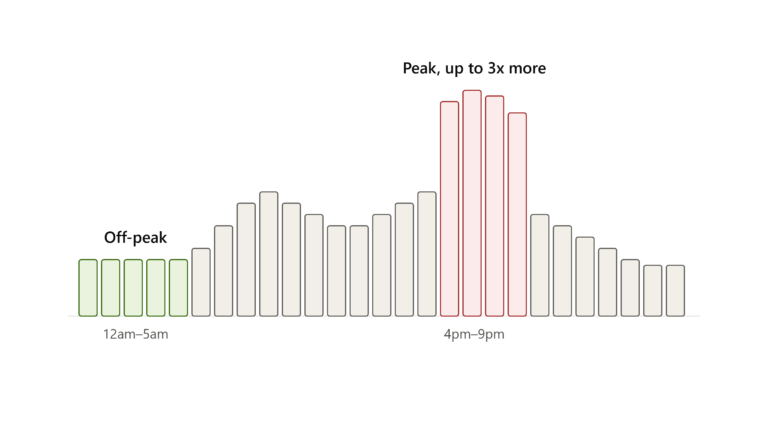
Off-peak schedulers: owners who shift charging to overnight, off-peak utility windows report the lowest costs of all — often $15-20 less per month than owners charging at standard rates, since off-peak electricity commonly runs 5-7 cents per kWh below standard residential pricing.
[AD BREAK — insert in-content ad unit here]
A Real-World Example: Solar-Charged Driving
Some owners report costs far below even the home-charging average by pairing an EV with home solar. One documented case from an owner who tracked results over two years and roughly 14,500 miles of driving found an average efficiency around 3.4 miles per kWh, with a total household electric bill (covering the home and EV combined) dropping to close to the utility’s minimum service charge — since most of the actual energy came from solar generation rather than the grid. This isn’t representative of typical costs (most owners don’t have solar), but it illustrates the range of outcomes possible depending on your setup.
Why the “Average” Number Can Be Misleading
A single “$50/month” headline figure assumes a specific vehicle, a specific mileage, and charging almost entirely at home — which describes a lot of owners, but not all of them. Your actual number depends on:
- Your vehicle’s efficiency (miles per kWh varies significantly between models)
- Your monthly mileage — well above or below the ~1,000-mile national average changes the math proportionally
- Your electricity rate, which varies significantly by state (see our state-by-state cost guide)
- How much of your charging happens at home vs. public stations
- Whether you use off-peak scheduling
Bottom Line
For the majority of EV owners charging mostly at home, $35-65 per month is a realistic, well-supported range — still 50-70% cheaper than the gasoline cost of driving the same distance. If your situation skews toward a larger vehicle, heavy public charging reliance, or well above-average mileage, budget meaningfully higher; if you have off-peak scheduling or home solar, you may land well below even the low end of that range.
Electricity rates, gasoline prices, and public charging costs change frequently and vary significantly by region. Figures in this article reflect national averages as of mid-2026; check current local rates for a more precise estimate of your own costs.