The honest answer is: it depends heavily on which charger you’re using, but here’s the range you can expect. On a standard 120V outlet (Level 1), a full charge takes 30-60 hours. On a 240V home charger (Level 2), that drops to 4-10 hours — easily done overnight. Here’s exactly what determines where you land in those ranges.
Level 1: Plan for a Full Day or More
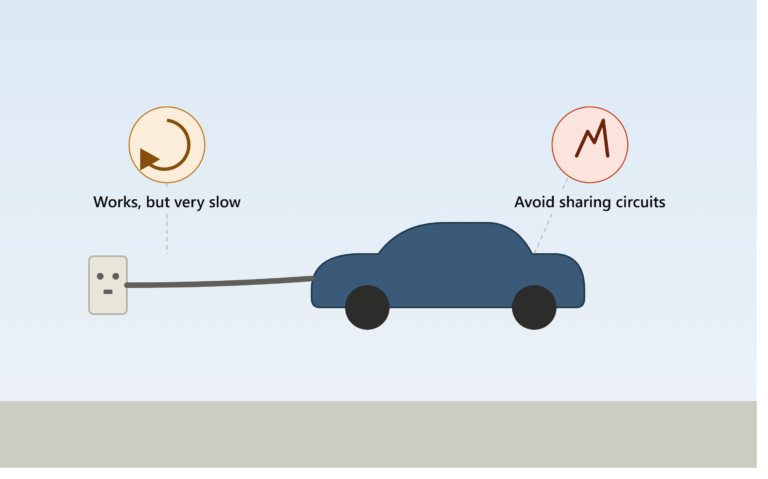
Level 1 charging uses the cable that came with your car, plugged into a regular wall outlet. It adds roughly 3-5 miles of range per hour, which means a full charge from empty can take 30 to 60+ hours depending on your battery size.
In practice, almost nobody charges from fully empty. Most EV owners plug in at 20-40% remaining and top up overnight, which is where Level 1 actually performs reasonably: a 10-12 hour overnight charge adds about 30-50 miles — enough for many people’s daily driving, even if a true “full battery from empty” would take days.
Level 2: The Overnight Sweet Spot
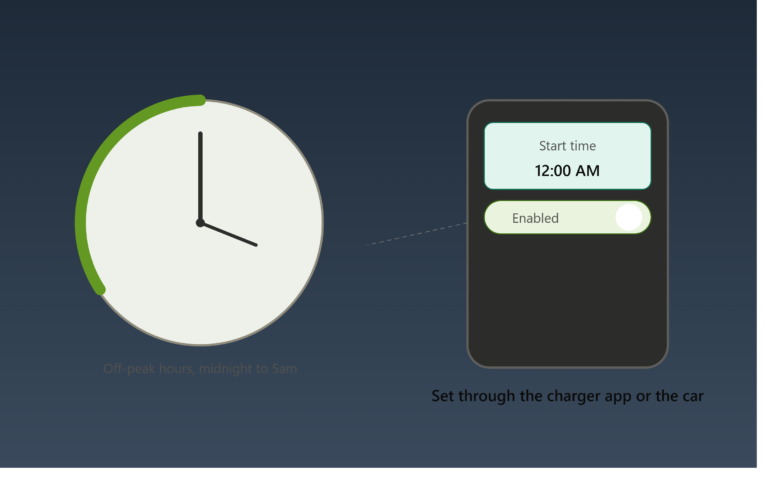
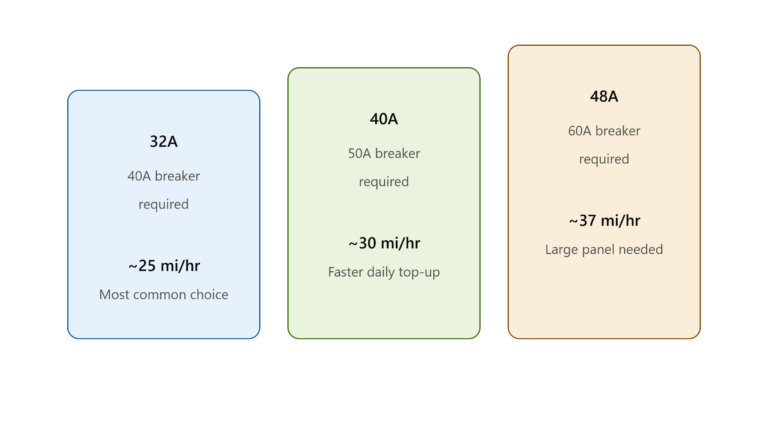
Level 2 charging uses a 240V circuit and typically delivers 6-19 kW, depending on your charger and your vehicle’s onboard charging limit. That translates to roughly 20-40 miles of range per hour, meaning most EVs go from empty to full in 4 to 10 hours — comfortably inside a single overnight window.
Here’s how that plays out for a few common vehicles on a typical Level 2 home charger:
| Vehicle | Battery size | Approx. full charge time (Level 2) |
|---|---|---|
| Nissan Leaf | ~40 kWh | ~5-6 hours |
| Tesla Model 3 Long Range | ~75 kWh | ~6-7 hours |
| Tesla Model Y Long Range | ~75-80 kWh | ~8 hours |
| Hyundai Ioniq 5 | ~77 kWh | ~7-8 hours |
| Ford F-150 Lightning | ~98-131 kWh | ~10-12 hours |
The Four Things That Actually Determine Your Charging Time
Charging time isn’t just about the charger you buy — four factors combine to set your real-world speed:
- Battery size — a larger battery simply holds more energy to replace, so trucks and long-range SUVs take longer than compact EVs at the same charger output.
- Charger output — home Level 2 chargers commonly range from 6 kW to 19.2 kW. A higher-output charger moves more electricity per hour, up to a point.
- Your vehicle’s onboard charger limit — this is the detail most people miss. Every EV has a maximum rate it can accept, regardless of how powerful your wall charger is. A car limited to 7.2 kW will charge at 7.2 kW even if it’s plugged into an 11.5 kW or 19.2 kW charger — the extra capacity simply goes unused. Check your owner’s manual before assuming a bigger charger will mean a faster charge.
- Temperature and starting charge level — cold weather reduces charging efficiency, and charging slows noticeably above 80% as the battery management system protects the cells. This is also why most drivers on road trips stop at 80% instead of waiting for 100% — the last 20% simply takes disproportionately longer.
Why Charging Slows Down Near 100%
This surprises a lot of new owners: charging speed isn’t constant throughout the session. Batteries charge fastest in the lower-to-middle range and taper off significantly above about 80%, as the battery management system throttles the rate to protect long-term battery health. In practice, this means going from 20% to 80% often takes a similar amount of time as going from 80% to 100% — even though the second stretch covers far fewer miles. For daily home charging, this rarely matters since you’re charging overnight anyway, but it’s worth knowing if you’re timing a charge around a specific departure.
Do You Need the Most Powerful Charger You Can Buy?
Not necessarily. If your car’s onboard charger caps at 7.2 kW (common on several plug-in hybrids and some standard-range EVs), paying extra for a 19.2 kW charger won’t get you a faster charge — your car simply can’t accept power that fast. A mid-range 32-48A charger is enough for the vast majority of home charging needs and typically costs less than top-tier units. The exception is if you’re planning ahead for a future vehicle with a higher charging limit, in which case a more capable charger can make sense as a one-time investment rather than an upgrade you’ll need to repeat later.
Bottom Line
For most households, a Level 2 home charger fully replenishes an EV overnight — typically in 4-10 hours depending on the vehicle — which is why the vast majority of EV owners never think about charging time as a daily inconvenience. Level 1 works fine as a backup or for low-mileage driving, but for anyone driving more than about 40 miles a day, Level 2 is what actually makes EV ownership fit into a normal routine.
Charging times are estimates based on typical conditions and can vary by vehicle, charger, temperature, and electrical setup. Check your vehicle’s owner’s manual for your specific onboard charging limit.