These three chargers dominate home EV charging for a reason — each does one thing better than the other two. ChargePoint wins on universal flexibility, Tesla Wall Connector wins on Tesla-specific integration, and Emporia wins on value. Here’s how to figure out which one actually fits your household.
Quick Answer
- Own multiple EV brands, or might switch someday? → ChargePoint Home Flex
- All-Tesla household, staying that way? → Tesla Wall Connector
- Want strong smart features without paying premium prices? → Emporia
- Tesla plus at least one non-Tesla EV in the household? → Tesla Universal Wall Connector (a distinct model with a built-in J1772 adapter)
Side-by-Side Comparison
| ChargePoint Home Flex | Tesla Wall Connector | Emporia (Classic/Smart) | |
|---|---|---|---|
| Max output | 16-50A (adjustable) | 48A | 48A |
| Connector | J1772 or NACS | NACS (Universal model adds J1772) | J1772 or NACS |
| Installation | Hardwired or plug-in | Hardwired only | Hardwired or plug-in |
| Cable length | ~23 feet | ~24 feet | Varies by model |
| Approx. price | ~$550-700 | ~$450-475 (Tesla-only) / ~$600 (Universal) | ~$400-599 depending on model |
| App | Most polished, ties into public ChargePoint network | Clean, Tesla-native | Functional, less flashy, strong energy monitoring |
| Best for | Multi-brand or undecided households | Tesla-only households | Budget-conscious buyers who still want smart features |
ChargePoint Home Flex: The Universal Choice
The Home Flex’s biggest advantage is flexibility: adjustable output from 16A all the way to 50A means it fits almost any electrical panel and any EV, and it’s available with either a J1772 or NACS connector — including versions that charge Tesla vehicles natively without an adapter. It supports both hardwired and plug-in installation, so it adapts to whatever your garage already has.
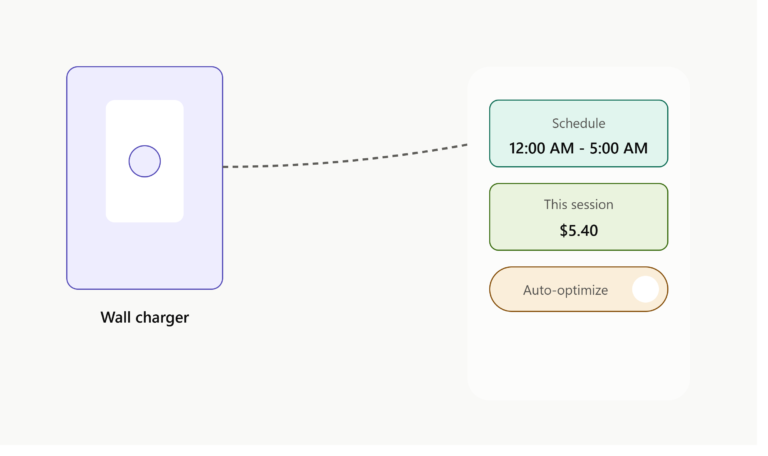
The app is consistently rated the most full-featured of the three: detailed cost tracking down to the penny, scheduling across dozens of utility rate plans, and integration with ChargePoint’s public charging network if you already use it away from home.
The catch: it’s usually the most expensive of the three, and if you’re firmly a one-brand household, some of that flexibility goes unused.
Tesla Wall Connector: Best for Tesla-Only Households
If every car in your driveway is a Tesla and will stay that way, the Wall Connector is hard to beat on value — it’s typically $100-200 cheaper than the ChargePoint at similar output, with a clean, Tesla-native app experience and support for power-sharing across multiple connectors if you add a second EV later.
There’s an important distinction to know about: Tesla sells both a Tesla Wall Connector (NACS only, cheaper) and a Tesla Universal Wall Connector (NACS plus a built-in J1772 adapter, roughly $600) for households with a mix of Tesla and non-Tesla EVs. If there’s any chance a non-Tesla EV joins the household, the Universal version is worth the extra cost over buying an adapter separately later.
The catch: hardwired installation only — no plug-in option — and if you ever add a non-Tesla EV to the standard (non-Universal) Wall Connector, you’ll need a separate adapter for full-speed charging.
Emporia: Best Value
Emporia consistently punches above its price class across independent reviews. The Smart/Classic models deliver the same 48A output as chargers costing $150-270 more, with real smart features — scheduling, energy monitoring, and app control — rather than a stripped-down budget experience. Some Emporia models also offer load management (sold as Emporia Pro), which can help homes with a 100-125A panel avoid an expensive panel upgrade by intelligently sharing available capacity.
The catch: build quality and cable feel are a step below ChargePoint and Tesla in some hands-on reviews, and a few users report occasional WiFi drops that can affect scheduled charging reliability. For most households charging overnight without needing precision scheduling, this is a minor tradeoff for the price difference.
The Question That Matters More Than the Brand
Across every comparison of these three, one detail comes up repeatedly: your electrical panel matters more than which charger you pick. All three require a dedicated circuit sized to their output, and homeowners regularly discover their 100A panel can’t safely support a full 48A charger from any brand without either a panel upgrade or a charger with load-management features (Emporia Pro specifically targets this scenario). Get your panel’s spare capacity checked before falling in love with a specific model.
Bottom Line
For most non-Tesla or mixed-brand households, the ChargePoint Home Flex is the safest all-around pick — flexible, well-supported, and unlikely to become obsolete if your next car is a different brand. Tesla-only households should default to the Tesla Wall Connector (or the Universal version if a non-Tesla EV might join later) for the best price-to-feature ratio. And if budget is the deciding factor but you still want real smart-charging features, Emporia delivers nearly the same core performance as the pricier options for meaningfully less money.
Prices, models, and specifications change frequently. Verify current pricing and compatibility with your specific vehicle and electrical panel before purchasing, and check your utility for available rebates on any of these models.