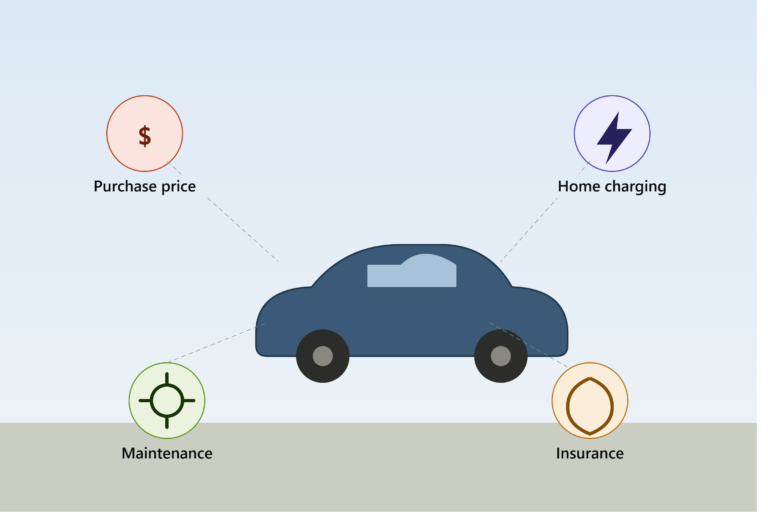
Lower fuel costs are real, and we’ve covered them in detail elsewhere on this site. But fuel is only one line item in the total cost of owning an EV, and several of the others run the opposite direction from what most buyers expect. Here’s what tends to catch new owners off guard financially — with real numbers, not vague warnings.
Insurance: Often the Biggest Surprise
This is the cost gap most new EV shoppers don’t see coming. A 2026 analysis of over 235 million insurance rates found that EVs cost an average of 42% more to insure than comparable gas vehicles — full coverage on an EV averages roughly $3,159/year nationally, versus $2,218 for a similar gas-powered car. That’s nearly $1,000 a year before you’ve spent a dollar on charging.
The gap comes down to repair economics, not risk of accidents: EV battery packs are expensive, many EVs use highly integrated structural designs that make collision repairs more complicated, and there’s a shortage of certified EV repair technicians in many areas, which raises labor costs and stretches out repair timelines. In some cases, relatively minor collision damage can push an EV toward a total loss where a comparable gas car would simply be repaired. Location matters too — insurance costs vary significantly by region, with some major metro markets running well above the national average.
Practical takeaway: get an insurance quote on the specific EV model you’re considering before you buy, not after — the gap varies a lot by model and can meaningfully change the total cost comparison against a gas alternative.
Tires Wear Out Faster Than You’d Expect
EVs are heavier than comparable gas vehicles (battery weight adds up), and instant torque accelerates tire wear. Most EV owners report replacing tires every 20,000-30,000 miles, compared to 40,000-50,000 miles on a typical gas car — roughly double the replacement frequency. For a mid-size EV, a full set of four tires runs $600-900 installed, meaning over 60,000 miles you might replace tires twice instead of once, adding several hundred dollars over a five-year ownership period compared to a gas vehicle.
The Home Charger Isn’t Optional Spending, Even If It Feels That Way
We’ve covered installation costs in detail elsewhere on this site, but it’s worth restating in a “hidden cost” context: a Level 2 home charger and installation typically runs $700-1,700 total ($500-900 for the unit, $200-800 for installation), and this is spending most new EV buyers don’t fully budget for upfront — it’s easy to focus on the vehicle price and treat the charger as an afterthought.
State Registration Fees Specifically for EVs
Because EVs don’t generate gas tax revenue that traditionally funds road maintenance, 32 states now charge an additional annual registration fee specifically for EVs (with 14 states also charging extra for plug-in hybrids). These fees range from roughly $50 to $250+ per year depending on the state — a recurring cost that’s easy to overlook when comparing sticker prices, since it doesn’t show up until registration renewal.
Depreciation Hits Harder and Faster
This one runs counter to what a lot of people assume about EVs holding value due to “new technology” appeal. In practice, the opposite has generally been true: some analyses show EVs losing up to 52% of their value within the first three years, compared to roughly 39% for gas vehicles over the same period. Rapidly evolving EV technology means older models can feel outdated faster than gas vehicles do, which tends to accelerate resale value declines. The steepest drop happens in the first two years — buying a lightly used EV (2-3 years old) rather than new is one of the more effective ways to sidestep this specific cost.
The Cost That’s Actually Better Than People Fear: Battery Replacement
To be fair to EVs, this often-feared cost is overstated in practice. Manufacturer warranties typically cover the high-voltage battery for 8 years or 100,000-120,000 miles, with a guaranteed capacity floor (commonly 70%). Real-world data shows most EV battery packs retain 85-92% of their capacity at 100,000 miles — meaningfully better than the pessimistic degradation stories that circulate online. Battery replacement before warranty expiration is genuinely uncommon. If you’re buying an older or high-mileage used EV outside the warranty window, an extended warranty or vehicle service contract covering the battery is a reasonable hedge, but this isn’t the routine expense many first-time buyers fear.
Putting It All Together
None of this means EVs are a bad financial decision — the fuel and maintenance savings we’ve covered elsewhere on this site are real and substantial over time. But the total cost picture is more complicated than “gas costs more, EVs cost less,” and the categories above are exactly where that nuance lives: insurance, tires, registration fees, and faster depreciation all work against the EV side of the ledger, while lower fuel and (genuinely) lower routine maintenance work in its favor. The honest comparison requires weighing all of it together, not just the part that makes the best headline.
Bottom Line
Before buying, get an EV-specific insurance quote, check your state’s EV registration fee, and budget for tires roughly twice as often as you would with a gas car. Factor the home charger installation into your total upfront cost rather than treating it as a footnote, and if you’re buying used, understand that a heavily depreciated 2-3 year old EV can actually be a smart way to sidestep the steepest part of the value curve rather than a warning sign.
Costs vary significantly by state, insurer, vehicle model, and individual circumstances. Figures in this article reflect national averages and industry data as of mid-2026.