If you’re trying to figure out what an EV will actually add to your monthly bills, the short answer is: most home charging runs $30-$65 per month, or roughly 4-5 cents per mile driven. But that range hides a lot of variation depending on your car, your state, and when you charge. Here’s the real breakdown.
The Simple Formula
Home charging cost comes down to one calculation:
Charging Cost = Battery Size (kWh) × Electricity Rate ($/kWh)
The U.S. residential electricity rate averaged around $0.16-$0.18 per kWh in early 2026, according to the Energy Information Administration. Apply that to a typical EV battery, and here’s what a full charge actually costs:
| Vehicle size | Battery size | Cost per full charge |
|---|---|---|
| Small EV (Nissan Leaf, Mini Cooper SE) | ~40 kWh | ~$6-7 |
| Mid-size EV (Tesla Model 3, Hyundai Ioniq 5) | ~60-65 kWh | ~$9-13 |
| Large EV / truck (Ford F-150 Lightning, Rivian R1S) | ~95-130 kWh | ~$15-20 |
For context, that mid-size charge covers roughly 200 miles of driving for less than $10 — something worth remembering the next time a $60 gas station fill-up feels routine.
What That Looks Like Monthly
The average American drives close to 1,000 miles a month. At typical home charging rates, that translates to about $35-60 per month for most mainstream EVs — compared to roughly $120-180 a month in gasoline for a comparable gas vehicle covering the same distance. Over a year, that’s often $700-1,000+ in fuel savings alone, before factoring in the lower maintenance costs EVs also tend to have.
Your State Changes This Math a Lot
Electricity rates vary more than most new EV owners expect, and it directly changes your monthly cost:
- Washington: as low as $0.12/kWh — some of the cheapest charging in the country
- Texas, most of the Midwest: generally $0.13-0.16/kWh
- California: around $0.30-0.32/kWh
- Hawaii: around $0.40-0.41/kWh — the most expensive state to charge in
That means the same EV, driven the same distance, can cost roughly two to three times more per month to charge in California than in Washington. If you’re deciding between charging at home and using public stations, or budgeting for an EV purchase, checking your actual utility rate (not just the national average) matters more than almost any other factor in this article.
Public Charging Costs a Lot More — Here’s the Real Gap
Home charging is consistently the cheapest way to power an EV. For comparison:
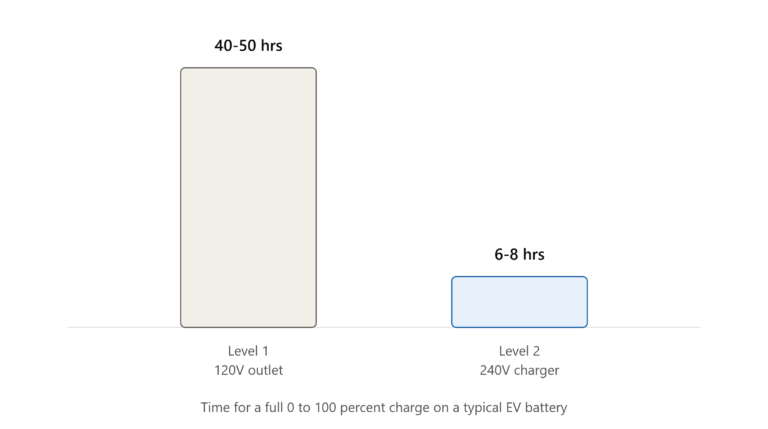
- Home (Level 2): ~$0.16-0.18/kWh (your standard residential rate)
- Public Level 2: ~$0.25-0.40/kWh
- DC fast charging: ~$0.41-0.53/kWh, sometimes higher during peak demand
That gap adds up fast. Someone who charges exclusively at public Level 2 stations instead of at home can pay roughly $1,000+ more per year for the same driving distance. Public fast charging closes most of the price advantage EVs have over gasoline — it’s convenient for road trips, but it’s not where the real savings come from.
The Easiest Way to Lower Your Cost: Off-Peak Charging
Many utilities offer time-of-use rates, where electricity costs significantly less late at night — often when most EV owners are charging anyway. Scheduling your charging session to run during these off-peak hours can bring your effective cost down to the equivalent of paying $1.15-$1.20 per gallon in a gas car.
The catch: studies suggest only about 38% of EV owners actually use scheduled charging, even though most modern chargers and vehicle apps support it. If you haven’t set this up, it’s likely the single easiest change you can make to lower your monthly bill — check your utility’s website for time-of-use plan options, then set your charger or car’s app to start charging automatically after the cheaper window begins.
Bottom Line
For most households, charging an EV at home costs a fraction of what the same driving would cost in gasoline — typically $35-65 a month versus $120-180. Your exact number depends heavily on your state’s electricity rate and whether you’re taking advantage of off-peak pricing, so it’s worth checking both before assuming the national average applies to you.
Electricity rates and incentive programs change throughout the year. Figures in this article reflect early-to-mid 2026 averages; check your utility provider for your current rate plan.