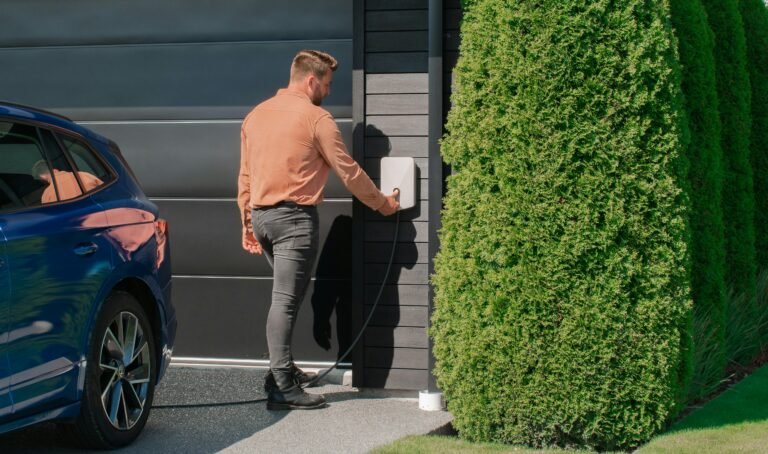
Roughly 36% of U.S. households rent, and most EV charging guides quietly assume you own your garage. If that’s not your situation, EV ownership is still genuinely workable in 2026 — it just requires a different strategy built around your specific building, routine, and local charging network rather than a wall-mounted charger of your own. Here’s the realistic playbook.
Step One: Find Out What Outlets Actually Exist
This single question determines your entire strategy, so it should be the first thing you check — before assuming you need public charging at all.
- Is there a 240V outlet near your parking spot? Even a dryer-style NEMA 14-50, if one already exists (in a shared laundry area, a garage utility outlet, or leftover from an RV hookup), means a portable Level 2 charger is your best solution: no installation required, no landlord approval needed since you’re using an existing outlet, and you take the equipment with you when you move (see our full guide on best portable chargers for renters for specific model recommendations).
- Is there just a standard 120V outlet? That’s enough for genuine Level 1 charging — zero installation, works tonight, and adds roughly 4-5 miles of range per hour.
- Is there nothing at all near your spot? Then your strategy shifts toward public charging integrated into your routine, covered below.
[AD BREAK — insert in-content ad unit here]
Level 1 Is a Real Strategy, Not Just a Stopgap
If you have garage or nearby outlet access, don’t dismiss Level 1 charging as inadequate before actually testing it against your real driving pattern. For commutes under roughly 60 miles a day, overnight Level 1 charging can cover the large majority of your needs without any installation or landlord conversation at all.
A few things matter for doing this safely and reliably:
- Ideally, use a dedicated, grounded 15-20A outlet that isn’t also running a freezer, lighting, or other equipment on the same circuit
- If you’re on a shared circuit with other tenants (common in apartment garages and shared parking structures), you may need to lower the amperage setting on your portable EVSE to avoid tripping breakers that affect your neighbors too
- Never run cables across a public walkway — keep everything contained within your parking bay, and use a cord cover if your building allows it
Build Public and Workplace Charging Into Your Routine, Not Around It
For most apartment-dwelling EV owners, the actual pattern that works is a mix: occasional Level 2 (at work, or once or twice a week at a public station) plus routine Level 1 at home covers 80-90% of typical driving needs, with DC fast charging filling occasional gaps rather than serving as the primary method.
The trick that makes this sustainable long-term: make charging happen while you’re already doing something else — shopping, working, at the gym — so it doesn’t feel like a dedicated errand. Spend ten minutes bookmarking charging locations near your workplace, your regular grocery store, and your gym using an app like PlugShare, ChargePoint, or EVgo, which show live availability, pricing, and connector compatibility. You don’t need every app installed — pick one map and one route planner and get comfortable with them.
Workplace charging, where available, is often the quiet hero of this strategy — even one or two sessions a week at work can meaningfully extend what your home Level 1 charging alone would cover.
[AD BREAK — insert in-content ad unit here]
How to Actually Ask Your Landlord (With Specific Questions)
If you want to explore installing something more permanent, come prepared with specific, low-commitment questions rather than a vague request:
- “Does the parking area have any existing 240V outlets or EV chargers?”
- “Would you permit installing a NEMA 14-50 outlet at my parking space if I cover the full cost?”
- “Are there public Level 2 chargers within a few minutes of the building?” (check PlugShare yourself first so you’re not asking blind)
If you’re proposing to add equipment yourself, make the request as easy as possible for the landlord to say yes to:
- Suggest a practical way to handle the added electricity cost — a dedicated sub-meter, a smart outlet that tracks your specific kWh usage, or a flat monthly fee added to rent based on typical usage
- Offer to sign an addendum stating you’ll pay for removal if you move out, and that you’ll maintain the equipment yourself
- Keep the proposal narrow and specific (one outlet, your own parking spot) rather than asking for a building-wide change
Know Your State’s Right-to-Charge Protections
A growing number of states have enacted laws that prevent HOAs, condo boards, and landlords from outright prohibiting EV charger installation, even if they can still set reasonable requirements around how it’s done. States including California, Colorado, Florida, Washington, Texas, and Illinois have some form of this protection (we’ve covered several of these specific state laws in our state-by-state incentive guides). Importantly, these laws generally protect your right to install at your own expense — they don’t obligate the landlord to pay for it, and the practical value is mainly in preventing a flat “no” to a reasonable, tenant-funded request.
What’s Changing on the Building Side (Worth Asking About)
Many older apartment buildings simply weren’t designed with the electrical capacity to support numerous residents charging simultaneously — this is a genuine infrastructure limitation, not just landlord reluctance. Newer solutions are changing this:
- Load-sharing and energy management devices now let buildings support EV charging using existing spare electrical capacity, without requiring a full electrical service upgrade for the property
- Some apartment complexes are beginning to offer dedicated or shared Level 2 charging as a building amenity, similar to how gyms or package rooms became standard offerings
- Utility programs increasingly fund multifamily charging infrastructure specifically (see our guide on state EV charger incentives, several of which include dedicated multifamily funding tracks)
If your building doesn’t currently offer this, it’s reasonable to ask whether it’s under consideration — property managers are increasingly aware that charging access affects a property’s competitiveness with EV-owning renters.
A Practical Decision Framework
- Check for existing 240V or 120V outlets near your parking spot — this determines whether you need to buy anything at all
- If nothing exists, map public and workplace charging near your regular routine before assuming you need a landlord conversation
- If you want a dedicated setup, approach your landlord with specific questions and a low-commitment proposal (tenant-funded, removable, metered)
- Know your state’s right-to-charge law if you get pushback on a reasonable request
- Reassess periodically — apartment EV charging infrastructure is genuinely improving year over year, and a “no” today may become a “yes” as your building adds capacity or amenities
Bottom Line
Renting without a dedicated parking spot is a real constraint, but it’s not a disqualifying one for EV ownership in 2026. The most sustainable approach combines whatever outlet access you already have (even just a standard 120V outlet) with public and workplace charging built into your existing routine, rather than trying to replicate a homeowner’s dedicated charger setup. If you do want something more permanent, a specific, tenant-funded, low-commitment proposal is far more likely to get a yes from your landlord than an open-ended request.
This article is for general informational purposes. Right-to-charge laws and landlord/tenant regulations vary by state and locality — confirm current rules applicable to your specific situation.