Georgia hasn’t had a state-level EV purchase tax credit since 2015, but the state makes up for it with an unusually large number of electric membership cooperatives (EMCs) running their own charger rebates and EV-specific rate plans. If you’re outside Georgia Power’s territory, there’s a good chance a smaller local EMC has something worth checking. Here’s the full picture.
Georgia’s State-Level Incentive: A Program That Ended a Decade Ago
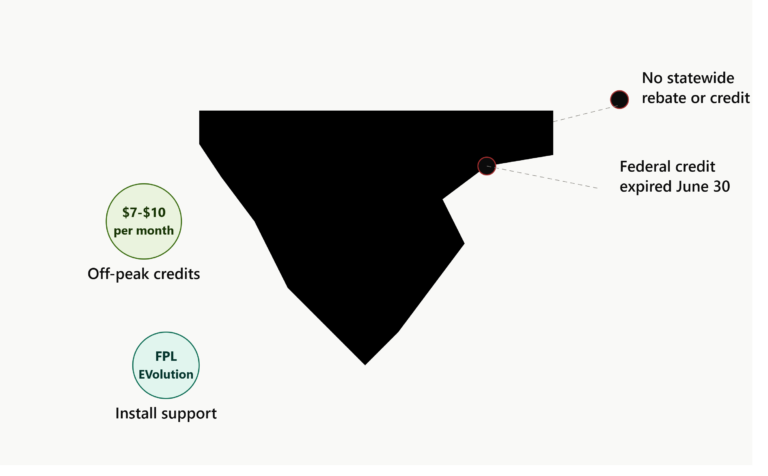
Georgia once offered one of the most generous state EV incentives in the country — a $5,000 income tax credit for zero-emission vehicles. That program ended for vehicles titled after July 1, 2015, and it has not been revived in any broad form since. As of 2026, Georgia has no statewide EV purchase tax credit or rebate. When people search for a “Georgia EV rebate” today, what they typically find instead falls into two buckets: utility-specific charger rebates (covered below) and a narrower state tax credit specifically for businesses installing charging infrastructure — not a consumer purchase or home-installation credit.
Georgia Power: Check the Current Rebate Amount Before Assuming a Figure
Georgia Power is the state’s largest utility, and it does offer a residential Level 2 charger rebate — but here’s something worth flagging honestly: the exact rebate amount has changed multiple times recently, with different current sources citing $150, $200, and $250 depending on when the information was published. Rather than commit to a single figure that may already be outdated by the time you read this, check Georgia Power’s current EV program page directly, or call customer service to confirm the active amount before purchasing your charger — this is a case where a specific dollar figure is genuinely less reliable than the general fact that a rebate exists and is worth applying for.
What’s consistent across sources: the rebate applies toward purchasing and installing a Level 2 charger, either through Georgia Power’s own charger marketplace or by submitting proof of purchase for an eligible model, and enrollment in Georgia Power’s separate EV charging rate plan is not required to receive the rebate.
Electric Membership Cooperatives (EMCs): Georgia’s Real Depth
Georgia has a notably large number of electric membership cooperatives, and many run their own charger rebates and EV-specific perks independent of Georgia Power. If you’re not a Georgia Power customer, check whether your specific EMC offers one of these:
- Carroll EMC: $250 rebate for a qualified Level 2 charger, plus a “Drive Free for a Year” program offering a $30/month energy credit during your first year of EV ownership (up to $360 total)
- Snapping Shoals EMC: $250 charger rebate, plus a matching $30/month bill credit for 12 months on EV purchase or lease
- Cobb EMC: $250 rebate for an ENERGY STAR-certified Level 2 charger, plus a time-of-use rate where charging during super off-peak hours while keeping total monthly usage below 400 kWh can result in no charge at all for that usage
- Coweta-Fayette EMC: $100 rebate for a Level 2 (240V), NRTL/UL-approved charging station, plus a separate time-of-use rate option
- Tri-County EMC: EV365 program, offering a $30/month bill credit during the first year of EV ownership
- Diverse Power: offers a charger rebate (confirm current amount directly, as figures for smaller EMCs change frequently and aren’t always centrally tracked)
- Sawnee EMC: runs multiple rate structures rather than a flat rebate — a standard time-of-use option (roughly $0.0445/kWh off-peak vs. $0.335/kWh on-peak) or a critical peak pricing plan with a lower standard on-peak rate but a steep $0.95/kWh critical peak rate during rare high-demand events. Sawnee also offers a dedicated EV charging program requiring a second meter, billing off-peak charging at roughly $0.04/kWh versus $0.28/kWh on-peak
Norcross (MEAG Public Power)
Norcross is currently the only MEAG (Municipal Electric Authority of Georgia) public power community offering a dedicated EV incentive — a $200 rebate toward a Level 2 charger for residential use. If you’re served by a different MEAG member community, this specific program likely doesn’t apply, but it’s worth checking whether your municipal utility has introduced something similar since.
The Real Cost Gap: Home vs. Public Charging in Georgia
Worth knowing regardless of which rebate you qualify for: Georgia’s home electricity rate for EV charging typically runs around $0.16/kWh, while public charging (particularly DC fast charging) can run closer to $0.41/kWh — meaning home charging in Georgia costs roughly a third of what public charging does per mile. This makes securing even a modest utility rebate on installation worthwhile purely on ongoing cost grounds, independent of the rebate amount itself.
What Happened to the Federal Credit
The federal Section 30C home charger tax credit (30% of installation cost, up to $1,000, in eligible census tracts) applied to qualifying Georgia addresses, but it expired for installations placed in service after June 30, 2026 — that deadline has now passed. If your installation was completed before that date, you can still claim it using IRS Form 8911 on your return for that tax year (see our full federal home charger credit guide for the filing process). Going forward, Georgia Power and EMC rebates above are your primary options.
A Non-Monetary Perk Worth Knowing: HOV and HOT Lane Access
Separate from any direct rebate, Georgia EV owners with a PeachPass can use high-occupancy vehicle (HOV) lanes regardless of the number of passengers in the car, and access high-occupancy toll (HOT) lanes at no additional toll cost. This isn’t a cash incentive, but it’s a real, ongoing benefit for commuters in metro Atlanta traffic that’s easy to overlook when focused only on charger rebates.
What About Businesses?
If you’re installing chargers for a business rather than your own home, Georgia does offer more substantial support: a state tax credit up to $2,500 (10% of cost) for commercial charging infrastructure, and Georgia Power runs a tiered commercial rebate structure — up to $2,000 for projects with five or fewer Level 2 chargers, scaling to $250/kWh (capped at $20,000/project and $40,000/year) for larger installations, and $100/kWh for DC fast chargers. This is a different program from anything covered above and doesn’t apply to a personal home installation.
Frequently Asked Questions
Why do EMC rebates seem more generous than Georgia Power’s in some cases? EMCs are member-owned cooperatives, and several have specifically prioritized EV adoption incentives as part of broader member benefit programs — it’s not unusual for a smaller EMC’s charger rebate or bill credit program to be more generous per-customer than the state’s largest investor-owned utility, since their programs and priorities are set independently.
How do I find out which utility or EMC serves my address? Check a recent power bill — Georgia has dozens of EMCs alongside Georgia Power and various municipal providers, and coverage can vary even between neighboring towns.
Is there any state-level rebate I’m missing for a personal home charger? No — as of 2026, Georgia’s only state-level charging incentive is the commercial tax credit for businesses. Individual homeowners rely entirely on their specific utility or EMC’s program.
Can I stack a Georgia Power or EMC rebate with anything else? Since the federal 30C credit has expired, current stacking mainly means combining a utility charger rebate with that same utility’s EV-specific time-of-use rate, which are typically designed to work together rather than being mutually exclusive.
Bottom Line
Georgia’s charger incentive landscape is fragmented but genuinely worth checking closely — Georgia Power offers a modest, recently-fluctuating rebate, while several EMCs (Cobb, Carroll, Snapping Shoals in particular) run rebates and bill credits that can add up to meaningful savings over your first year of ownership. Confirm your specific utility or EMC and their current program directly before purchasing a charger, since amounts and terms in this state have changed noticeably even within the past year.
Utility rebate programs, amounts, and eligibility requirements change frequently. Verify current program status directly with Georgia Power or your specific EMC before making installation decisions.